
 Whatsapp
 Telegram
 2026-02-20
 The gold price remains in a volatile pattern for the short term.
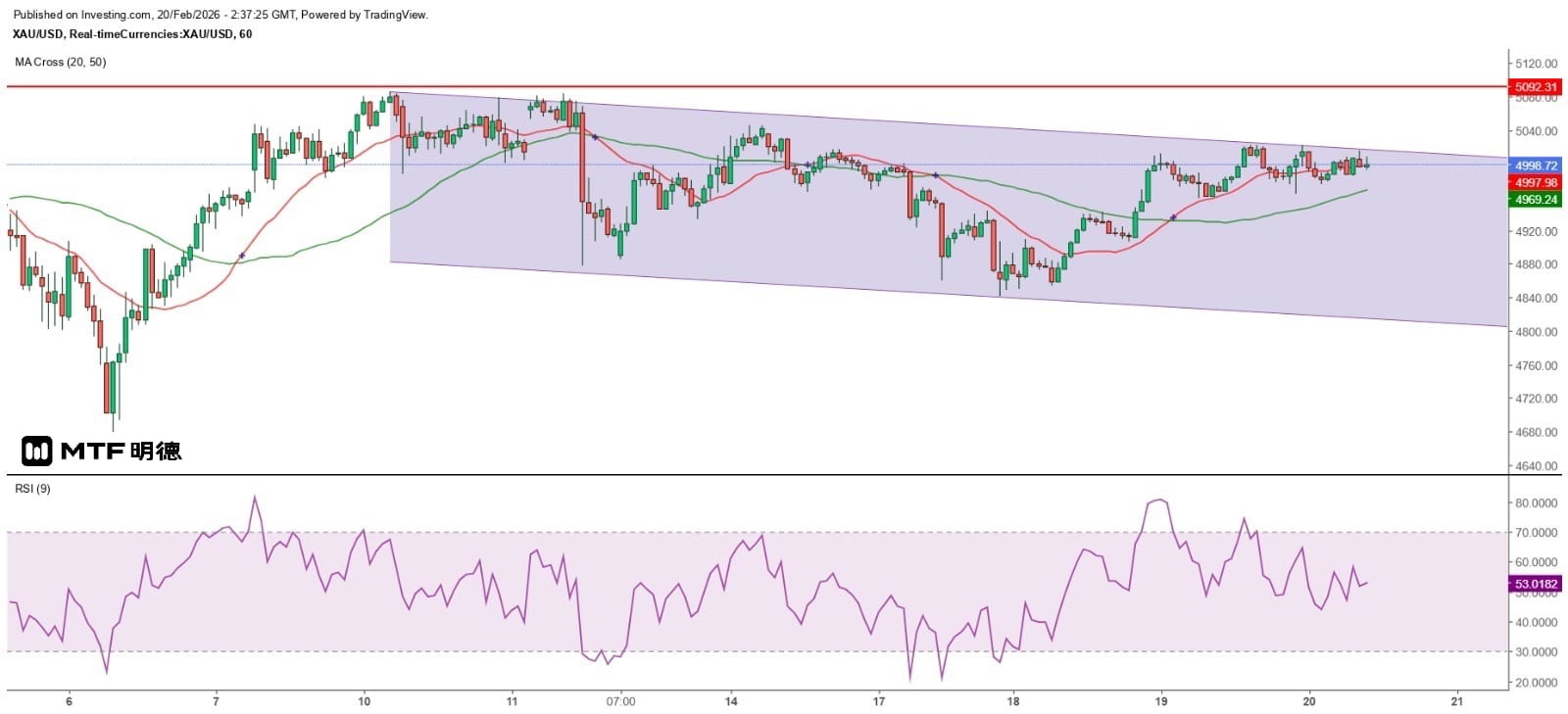
"Gold Price to Remain Volatile in the Short Term" 20/2/2026 10:31 Completed
Entering the Year of the Horse, I wish everyone a spirited and successful year ahead!
During the three-day Lunar New Year holiday in the past three days, the gold price has remained largely within a range. Although the spot gold price rose above $5,000 on three occasions, it failed to close above that level. From the daily chart, the gold price has closed below the 20SMA (currently around $5,007.33) for three consecutive days, the first time since it re-broke above the 20SMA on November 10 last year. This indicates an increased risk of a further sharp decline in the gold price.
From the hourly chart, since the rebound from the low of $4,402 on February 2nd, the gold price has been clearly constrained by $5,100 and has formed a large sideways range, indicating that $5,100 has become an important medium-term resistance level for the gold price. Moreover, over the past three days, it has failed to close above $5,000, which can be regarded as an important short-term resistance level. In other words, the gold price must break through $5,100 to have a chance to break the sideways pattern. Even if it rises back above $5,000, it is very likely to remain sideways between $5,000 and $5,100.
Gold prices rose to $5,015 in the early Asian session today, but closed with a bearish candle on the hourly chart. Yesterday, gold prices hit a low of $4,959.15 in the early Asian session and $4,964.09 in the early New York session, both near the 90-degree angle of $4,960 on the Gann Square. Therefore, whether it can hold this level is crucial. If $5,100 is confirmed as the medium-term resistance, the upward test of the 135-degree angle at $5,110 centered on the 90-degree angle at $4,960 has ended, and gold prices will test the 45-degree angle at $4,810 in the short term.
Tonight, the United States will release not only the initial estimate of the fourth-quarter GDP but also the December personal consumption expenditures (PCE). It is expected that the overall year-on-year increase will remain at 2.8%, while the core PCE's year-on-year increase is projected to expand from 2.8% to 2.9%. Based on this data alone, the impact on gold prices is negative. However, the United States will also release other important economic data tonight, including the S&P's February PMI, the University of Michigan's February consumer sentiment index and one-year inflation expectations, as well as December new home sales. All of these can serve as excuses for market speculation, and gold prices are expected to remain in a volatile pattern in the short term.
The above content is for reference only and does not constitute investment advice.


