
 Whatsapp
 Telegram
 2026-11-06
Gold Prices Have Strong Support at the Mid-Term $4,000 Level
Gold Market Analysis: “Gold Prices Have Strong Support at the Mid-Term $4,000 Level” Completed on 11 June 2026, 11:07
After a day of euphoria, the three major U.S. stock indices plunged yesterday, forming a two-day reversal pattern. The Nasdaq Composite fell more than 5.5%, marking its largest single-day decline in 19 months, while the S&P 500 and the Dow Jones Industrial Average also plunged more than 4.3% and 3.4%, respectively. One reason is that the Democratic Party will strengthen regulation of the AI industry next year. In addition, after a crushing defeat in the midterm elections, Trump may order large-scale military action against Iran. According to relevant officials, U.S. and Israeli forces have drawn up concrete plans to carry out a short but intense military operation, most likely targeting Iran’s energy infrastructure, nuclear facilities, and missile and drone arsenals.
Although there are still nearly two months left until the end of the year, the Nasdaq Composite has shown a head-and-shoulders pattern on the monthly chart in October, a strong signal of a reversal to the downside. This reflects influential investors reducing their positions ahead of the midterm elections and even beginning to exit the market. U.S. 10-year Treasury yields briefly fell to the edge of 4.8%, while New York crude oil futures rebounded slightly after several days of sharp declines and hovered around $91 this morning. However, if the United States launches another military strike against Iran, the purpose would be not only to prevent Iran from acquiring nuclear weapons, but also to open up the Strait of Hormuz. In that case, any rise in oil prices would be short-lived. Moreover, environmental protection and new energy have become a major trend, and the use of fossil fuels has already begun to decline.
Historical data show that oil prices at $100 per barrel have been sustained for only a short period, while they have spent a longer time fluctuating below $80. Although oil prices and gold prices are highly correlated, apart from the impact of oil prices, interest rates and risk sentiment are the main factors affecting gold prices. If stock market investors begin to prepare for risk aversion, even if the Federal Reserve is inclined to raise interest rates in December, not all risk-averse funds will flow from the stock market into U.S. Treasuries; some will inevitably flow into the gold market. Coupled with speculative buying, gold prices are not unlikely to embark on a new strong rebound wave.
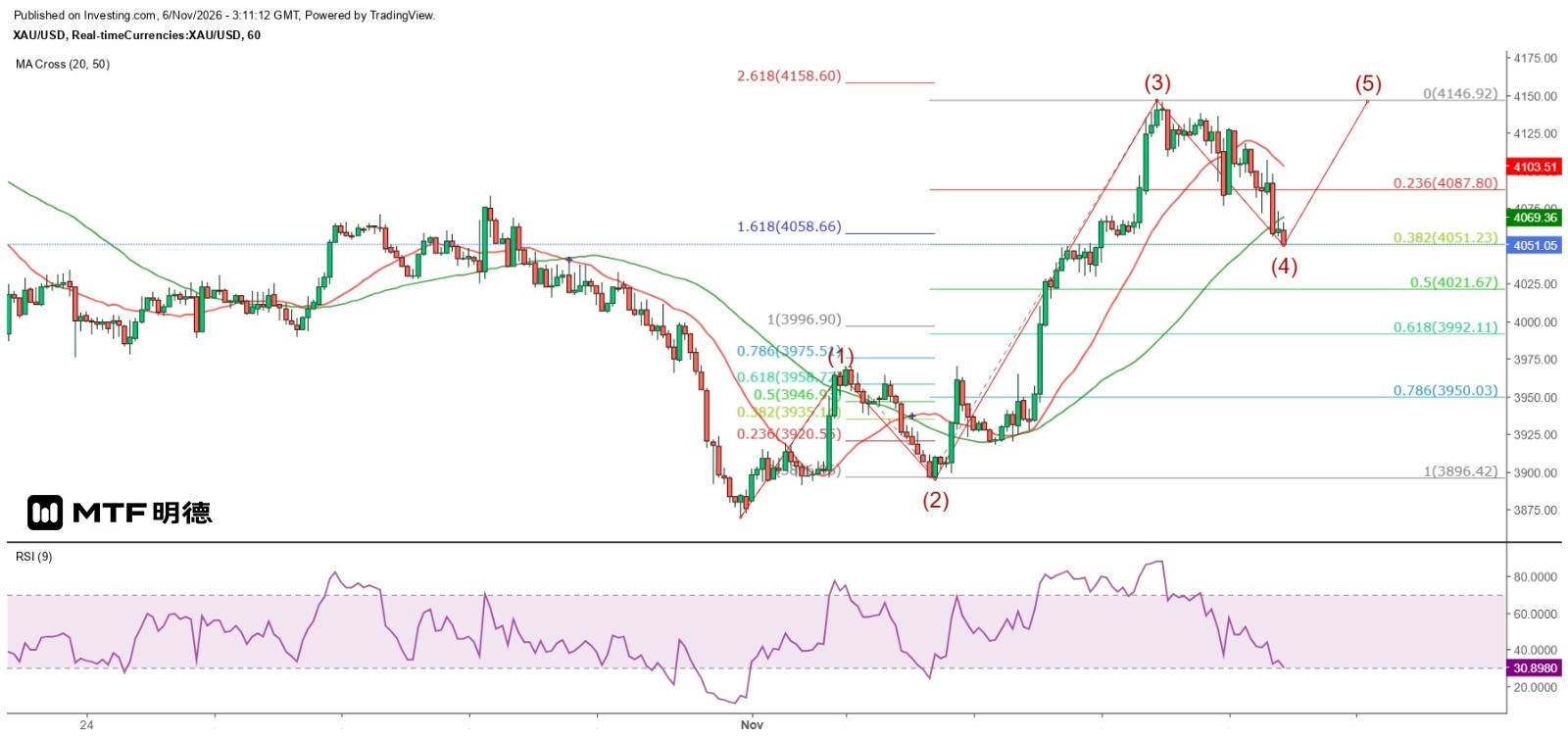
At present, gold prices are contending around the 20-day SMA ($4,066) on the daily chart. From the hourly chart, gold prices are in a four-wave corrective wave, and the correction should not exceed 50% of Wave 3. The preliminary expectation is that after stabilizing at $4,051, gold prices will launch a five-wave upward move, with $4,160 or $4,210 as the upside targets. However, if the rebound is weak and prices fall further, there should be strong support around $3,975.5, after which a higher-degree Wave 3 will begin, and it will certainly break above $4,146.92.
The above content is for reference only and does not constitute investment advice.


