
 Whatsapp
 Telegram
 2026-08-11
 The gold price has a high chance of reaching its peak today.
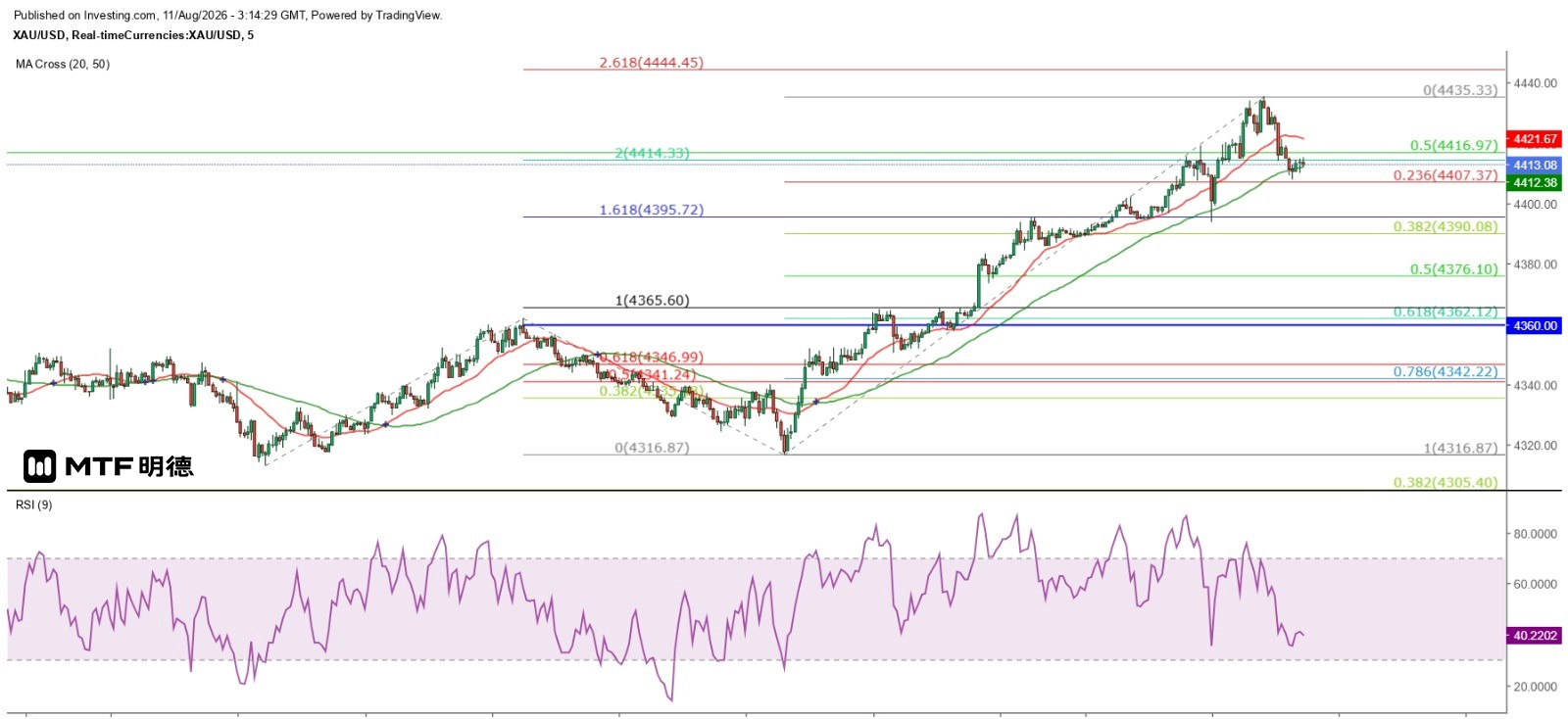
"High Chance of Gold Reaching a Peak Today" – Completed on 11/8/2026 at 11:12
The weakening U.S. labor market has provided investors with a reason to sell the dollar. On August 5, following weaker-than-expected July ADP private employment data, gold prices broke above the daily chart's 50-period SMA (currently around 4,150), gaining momentum. This morning during early Asian trading, gold surged as high as $4,435.33—breaching both the Gann square’s 270-degree vertical angle at $4,410 and the 50% retracement level of the largest drop since April 17 at $4,416.97. However, it subsequently pulled back repeatedly and remains temporarily above $4,410.
Nevertheless, attention should be paid to tonight’s release of the U.S. July CPI data. Market expectations are for the year-on-year increase to decline from 3.5% to 3.4%. Even so, inflation would still remain above the 3% threshold, leaving little justification for rate cuts. Moreover, the Federal Reserve does not base its monetary policy solely on one month’s employment data. Additionally, tensions between the U.S. and Iran could worsen again, as both sides demand compensation for losses and casualties caused by military actions. This has pushed New York crude oil prices back above $80. If the Strait of Hormuz continues to face prolonged disruptions in shipping capacity, oil prices could rise further, which would likely push gold prices lower.
Looking at the 5-minute chart, gold is currently testing the 50SMA (currently around $4,411) for the second time this morning in Asian markets. A confirmed close below this line would likely trigger a rapid decline. If the correction reaches 61.8% of yesterday’s overnight rally in New York, gold could fall to $4,362.12—roughly within the range between the strong resistance at $4,410 and weak support at $4,310. Judging by short-term cyclical patterns, gold appears to have peaked today, and is expected to trend downward over the remainder of the week. Even if it holds steady above $4,410 in the near term, a challenge toward $4,460 remains possible only if U.S. inflation drops sharply below 3%. Otherwise, the likelihood of reaching the 61.8% retracement level of the largest drop since April 17—$4,528.53—is slim.
The above information is for reference purposes only and does not constitute investment advice.


